SMART CITY POLICY BETWEEN INSTITUTIONS AND CITIZENS:
THE PERSPECTIVE OF THE CITY OF MILAN
DOI: https://doi.org/10.36004/nier.es.2023.2-02
JEL classification: L91, L98, O18, O38, R42
UDC: 352:004+338](450.251)
Mariano MELCHIONDA,
PhD. in Economics and Business Administration, master degree in Business and Management Consultancy, Chartered Accountant and Administrative Officer of a Public Authority.
https://orcid.org/0000-0002-8430-1251
mariano.melchionda15@gmail.com
Received 05.07.2023
Accepted for publication 17.10.2023
SUMMARY
In the environmental and climate issue, a decisive role is played by mobility. In recent years we are witnessing a kind of transportation revolution, especially urban transportation, with a sustainable mobility.
It is today one of the many aspects in which cities need to renew themselves, thus facilitating their transition to the smart city dimension.
The smart city represents the latest trend in urban planning aimed at improving the quality of life. It is now widely talked about: in politics, for example, the concept is used to illustrate new urban development strategies aimed at improving the architecture, mobility and infrastructure of metropolises.
However, although the idea of a smart city is based on the use of modern technologies, it is considered "smart" when it innovatively manages its economic and environmental resources, housing and transportation policies, relations and methods of administration.
Smart cities focus on environmentally and sustainable urban development, using technology to reduce pollution or generate alternative energy.
The study therefore aims to analyze how a smart city develops and what are the main actors and elements that play a key role in the analysis of the topic: institutions and citizens.
By harnessing information communication technology and improving local infrastructures and transports, the institutions of the city of Milan proactively monitored city dynamics, drove positive changes, and enhanced residents’ quality of life.
This enabled direct engagement with both residents and infrastructure, making Milan one of the most cutting-edge cities not only in Italy, but also in the international context.
Keywords: infrastructures, mobility, smart city, technologies, transportations.
INTRODUCTION
Based on expert opinions, a “smart city” can be defined as a technologically driven community that emphasizes the importance of monitoring and integrating services with IT intelligence. This approach aims to optimize access to information and public services while educating citizens about its significance (Penaska & Velas, 2019)
As a result of the demands of smart city, different ideas evolve in time (or new ones are developed). Large urban areas require majority of the attention while creating smart city, because of their intricate networks and systems (Picon, 2019).
The goal is to develop an analysis that can predict the problem, as well as assessing the level of preparedness by providing actionable steps that can be swiftly implemented.
The study therefore aims to analyze how a smart city develops, and what are the main actors and elements that play a key role in the analysis of the topic.
The growth of the city is largely dependent on its infrastructure, which is essential to both the operation of commercial organizations and the general well-being of the populace.
In urban management, infrastructure is classified into two groups, namely soft (social) and hard (technical). Soft (social), is in the form of social, cultural, and other facilities, while hard (technical) infrastructure, is presented as transportation, telecommunications, water, and energy networks. Smart city is the result of harmonizing urban environments with the transformative power of digital technologies, driven by the needs and opportunities presented by the Internet (Sodhro et.al., 2019). Technologically, its policy aims to build integrated city information and management (Neirotti, 2014) combining perception, network, and applications in achieving a measurable and connected future city according to the needs of the community.
Its conceptual framework can be classified into 3 factors, namely technology, people and institutions. (Nam, 2011). This development is able to drive social capital and information technology infrastructure toward a sustainable growth.
The policy of a smart city highlights that it is not merely using modern technology, but also a complex ecosystem made up of many stakeholders, including residents, municipal authorities, local and industrial businesses, community, and organizations (Myeong et.al., 2018).
LITERATURE REVIEW
Smart city policy serves as a framework or guide in planning and implementing smart city initiatives. This policy covers strategic decision-making related to ICT infrastructure, data use, cybersecurity, community participation, and other aspects related to smart city applications.
According to authors D. Van Den Buuse and A. Kolk (2019), globalization has caused significant changes, prominently marked by the widespread availability of the Internet. Education, religion, sports, business, commerce, politics, government all spread information online and digitally (Amini et. al., 2018). The use of internet technology gave rise to the policy of e-learning, e-books, e-commerce, e-government, and smart city policy. Smart city development needs to be supported by social, economic, environmental conditions, and with participatory government.
Several cities in the world have planned to develop well-established infrastructure and implemented smart city initiatives that are priorities for sustainable development.
Acceptance/usage of ICT-based smart city service describes several indicators in the acceptance of IT-based smart city technology, including quality of life, innovation policy, personal innovations, city engagement, service quality, perceived privacy, and trust.
Smart city policy should be supported by the role of ICT infrastructure, although many research also showed the importance of human capital, education, social capital, and environmental interests as drivers of urban growth.
According to C. Harrison (2010), Smart city can respond intelligently to a variety of demands, such as necessities of life, environmental protection, energy security, public safety, municipal services, business, and industrial operations. He considers to integrate physical, IT, social, and commercial infrastructure to harness the collective intelligence of its residents and resources.
Author A. Picon, in “Urban infrastructure, imagination and politics” (2019) considers a smart city serves as a source of inspiration, motivating its citizens to develop and flourish in their personal lives, fostering a culture of sharing information, knowledge, and experiences that enriches life and imparts positively.
DATA SOURCES AND USED METHODS
The development of adequate urban mobility, like the case of the city of Milan, is one of the priorities that many cities have pushed to improve: mobility, in fact, is the basis of human beings, communities, and countries; human beings feel the need to move, to travel, whether for exploring or for work purposes.
It is therefore natural to think that high quality transportation (of both goods and people) is necessary for the success of other sectors and as an attractive factor for the citizens of Milan, tourists or those visiting the city for work purposes (ARUP, 2019). In Italy, ANCI1 wanted to give its definition of Smart Mobility.
It is possible to identify what the National Association of Italian Municipalities believes smart mobility should achieve; since smart mobility should solve the problem of moving goods and people without creating traffic congestion or logistical problems, it must be divided into two fields:city logistic: "is to be understood as the process that can optimize last-mile logistics and transport activities proper to private companies in urban areas."
people's mobility: "concerns [...] the development of new environmentally friendly and sustainable mobility systems (pedestrian mobility, bicycle mobility, shared mobility and new solutions for local public transport)".
In both fields, at a transversal level, it is possible to identify "pricing and tolling policies and parking systems, research and effective integration of new alternative energy sources to oil in the specific area of mobility and transport."
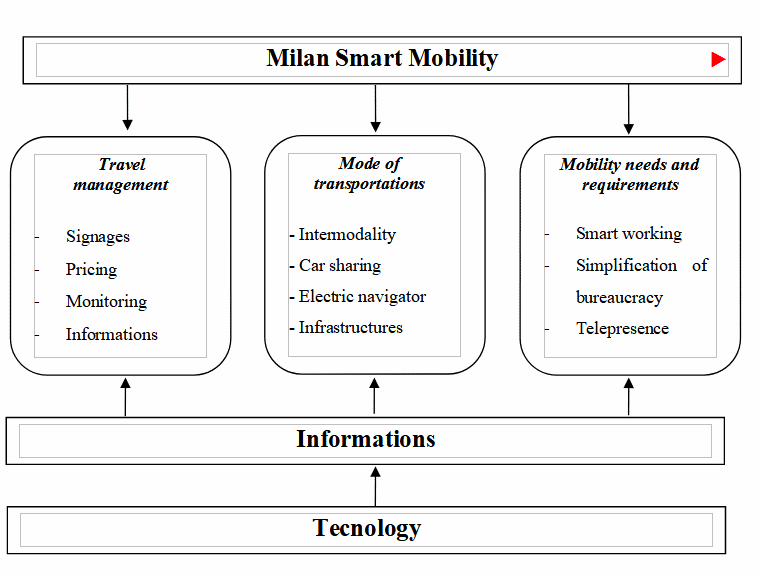
To support these activities, technology would be able to ensure the collection of information regarding travel management, transportation tools and modes, and mobility needs and requirements, through which the smart mobility vision can be improved.
The infrastructures that manage urban and intercity transportation were less and less able to handle the continuous demand for improved service, so for that reason the municipality of Milan has decided to increase the investments on transports and infrastructures to better respond this augmentation of movement of vehicles and people (ARUP, 2019).
In fact, the use of the private car remains the most frequently used mode of transportation, representing the preferred transportation choice at the European level in 2011 (84 percent), followed by buses and coaches with 9 percent and rail transportation with 7 percent (Bosetti, 2014). This choice by the population causes many inconveniences, often related to the environment and quality of life. In addition to the internal costs that everyone has to bear in order to ensure their autonomy and mobility, it is possible to see how the external costs of sustainable mobility, which burden to the city of Milan and the entire community, are often due to (Cassa Depositi e Prestiti, 2013)
greenhouse gases (human health, agriculture, climate change, water availability);
air pollutants (human health, damage to buildings, land, water);
noise pollution (human health, building interventions, vibration);
congestion (time loss, health, production system inefficiency);
safety (quality of life, health, accidents).
reduce consumption of fossil fuels used for infrastructure and vehicles for the benefit of green transport with low greenhouse gas emissions and improved air quality;
reduce road congestion;
create a simple, efficient and economically sustainable long-term system that is convenient for both businesses and travelers by reducing the demand for infrastructure construction in urban areas.
For this reason, we can consider the city of Milan as a city that aims today: “The Smart City 4.0”: that is a city that manages resources intelligently, aims to become economically sustainable and energy self-sufficient, and is attentive to the quality of life of its citizens.
The figure below shows 3 indicators that the institutions of Milan have identified:
Fig. 1: Milan Smart Mobility Structure
Source: The European House – Ambrosetti (2012), Smart Mobility. Muoversi meglio per vivere meglio.
The continuous increase in demand for mobility and the need therefore to move toward "smart mobility" has been linked to the mega-trends that characterize our age: urbanization, new demographics, trans-nationalism, acceleration, have triggered critical needs that also include the need for the development of safe, sustainable, and quality mobility for goods, people, and ideas:
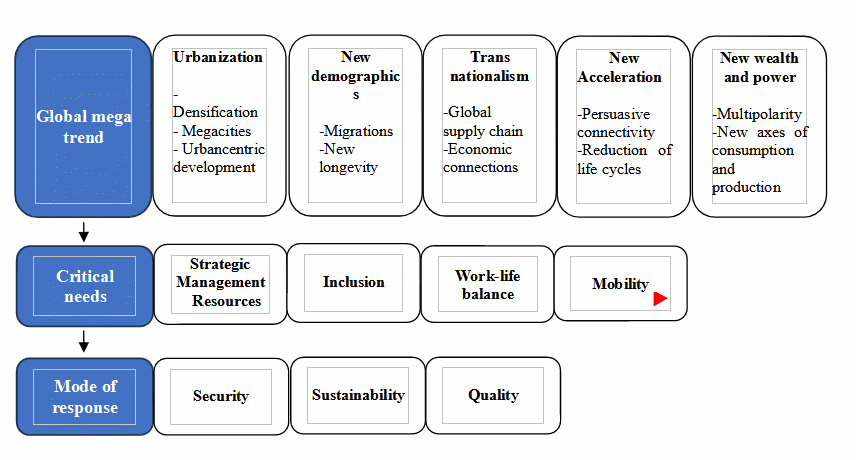
Fig. 2: Global mega trend
Source: The European House – Ambrosetti (2012), Smart Mobility. Muoversi meglio per vivere meglio.
Moreover, the development of sustainable mobility is to be linked to areas that indirectly influence it in many ways. They can be mentioned (The European House - Ambrosetti, 2012):
strategic policy (governance, security, regulation, etc.);
demography and society (population trends, urbanization, ways of organizing work)
economics (growth, trade, economic integration, transportation costs, etc.);
ICT (information communication and technologies)
energy and environment (availability of energy sources, alternative fuels, climate change, etc.);
behavior/approach (civic education, safety, etc.).
This list represents just a few areas that can be improved through the development of good urban mobility service. The table below instead shows in details the most affected areas of a sustainable mobility: infrastructure and telecommunications, sensors, service delivery platform, applications and services with its vision and strategy.
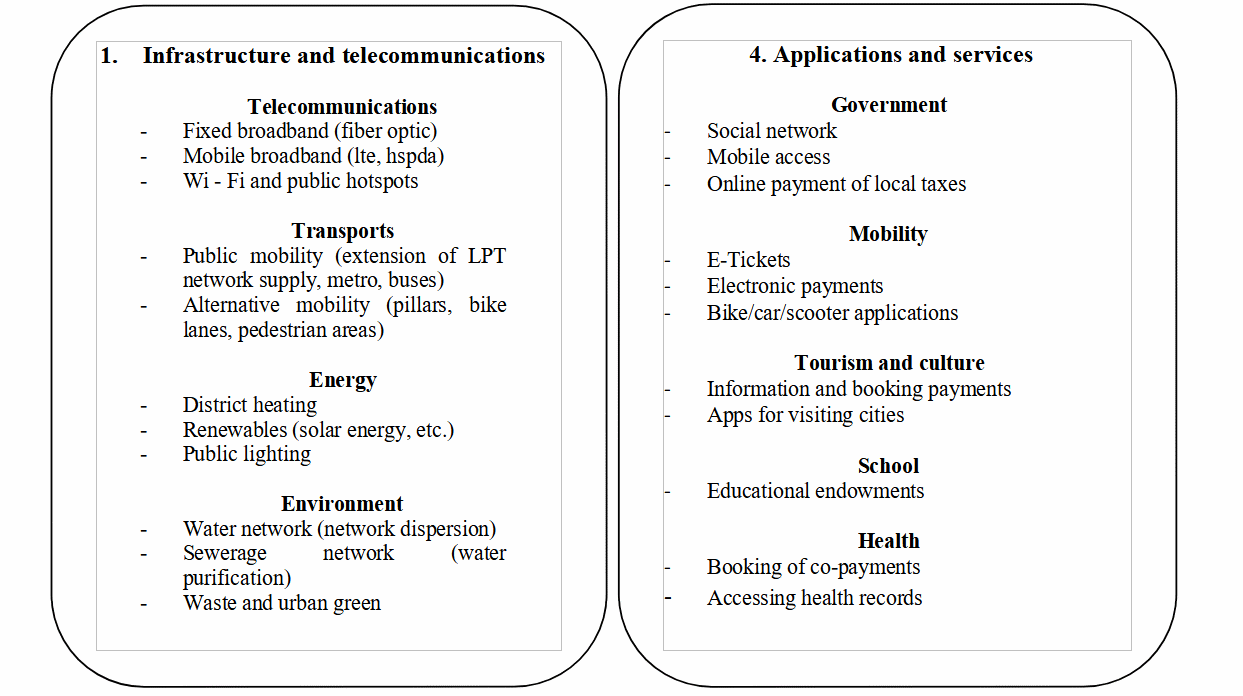
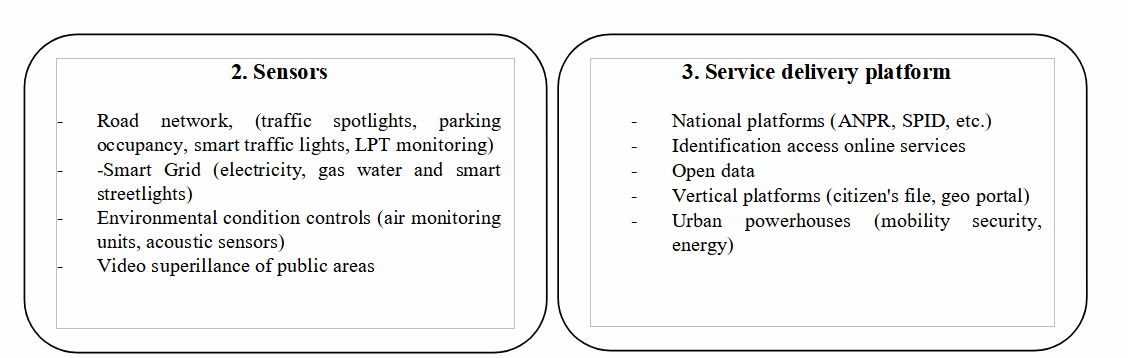
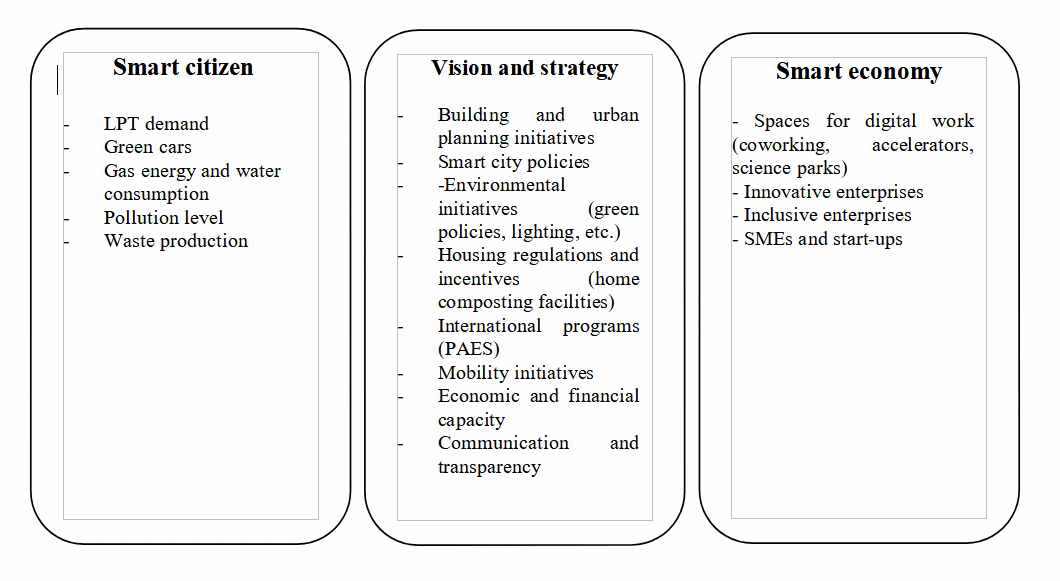
Fig. 3: The "smartness" of a city, below the "smartness" of a city.
Source: Smart cities: l’eccellenza di Milano nel confronto europeo, (2018) Confindustria.
THE RESULT OF RESEARCH AND DISCUSSIONS
Passing to analyze the numbers, The city of Milan has been confirmed as Italy's top Smart City for the past five years, which shows Florence and Bologna in second and third place as a city's level of "smartness.". (FPA's ICity Rate, 2018). The two accolades are linked: smart cities are more attractive and competitive than the average of other cities and are an important driver for a country's economy, as well as fostering the well-being of its citizens. The report below analyzes the Smart City Index by Italy's 117 capital cities, also lists Milan as the smartest city in Italy, followed by Turin, in second place, and Bologna, in third. Below is the national ranking compiled by EY of the top 30 Italian cities (SmartforCity, 2016).
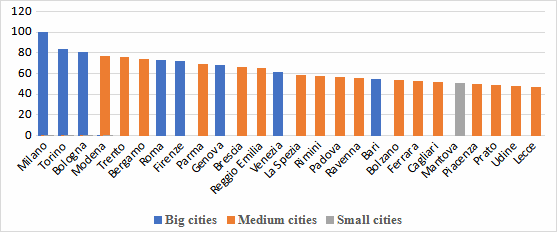
Fig. 4: Top 30 Italian cities.
Source: Smart City Index by Italy's 117 capital cities, Ernst & Young
Business models inspired by the sharing economy and digital technologies are helping to create innovative ways of moving from one place to another: think of ride sharing and on-demand services such as Uber or Lyft or car sharing or bike sharing programs, there are many different technological solutions that pertain to smart mobility. The ultimate goal is to make movements and flows more efficient and less polluting. At the same time, the generation of an immense amount of data is initiated, which, if well managed, can enable a rationalization of mobility itself but also the enabling of new model of businesses.
The following are a series of guidelines (Comune di Milano, 2023) launched by the municipality of Milan to show the commitment of a variety of actors working together to achieve sustainable mobility goals.
The micro mobility service was introduced in February 2020 at the conclusion of a regulatory process that defined the areas of experimentation and led to the liberalization of electric micro mobility by equalizing the rules of use with those of bicycles.
This is the first step on a path that will revolutionize transportation in population centers, especially in large cities. The use of electric scooters is managed by a smartphone application called Helbiz, (Helbiz monopattini Milano,2019), which is used both to geolocate the vehicles being searched and to unlock them. This makes it possible to carry out an 'accurate LCA (Life Cycle Assessment) analysis of the product, that is, to indicate the set of activities aimed at identifying the associated environmental loads generally associated with a product starting from the extraction of raw materials, production and distribution, until its disposal and/or reuse, recycling etc., following all phases of its life in accordance with ISO14040 Environmental Management - Life Cycle Assessment and ISO 14044 with requirements and guidelines.
Turning instead to carsharing, where services are readily available, there is great demand: 1 in 2 Milanese have tried at least one carsharing service, and 16 percent of carsharing users aim for complete replacement of the private car. In fact, to date carsharing in Italy has exceeded 1 million members, with 7,679 vehicles and 35 cities involved. (Sharing Mobility Observatory, 2019).
Moving to bicycles there is BikeMi, with 3,650 traditional bikes (yellow) and 1,150 pedal-assisted bikes (red), that is the world's first example of an integrated bike sharing system, unique in size, complexity and innovation (Milano Bike City, 2019).
A recent study by Juniper has drawn up a ranking of the main Smart Cities currently present. At the top of the smart city classification Singapore is one of the most technologically advanced areas on the planet. Also showing off in the ranking are San Francisco and, on our continent, London and Barcelona.
Milan at the moment seems to be the only one capable of launching itself on every aspect, from city governance to opportunities for the digital economy up to projects of a social nature and those linked to respect of the environment (Nicma Informatica, 2023).
The result is that the gap between Milan and other Italian cities is increasing. An opportunity for the city, but at the same time a possible risk factor. Faced with a future gap between Milan and the rest of the country at the Smart City level, one possible scenario is that investments increasingly gravitate towards the city. But a technologically advanced oasis surrounded by desert will hardly be able to obtain optimal results in the long term. In Italy, excluding Milan and some other cities, is essentially at a standstill in terms of investments as well as lacking a political control room in defining the possible areas of public investment and private.
In fact, it should be remembered, returning to the initial definition, that a Smart City is not a space filled with advanced technology without any criteria but an intelligent ecosystem, which lives thanks to the technological value present within it.
CONCLUSIONS
People’s need for ICT is becoming an important factor in smart city applications. ICT can improve people’s quality of life in various aspects, such as efficiency, comfort, safety, and public participation (Albino, et.al., 2015).
Within the framework of smart city, ICT is used to connect Milan’s infrastructure, services, and resources to provide better benefits to society. Therefore, understanding the needs of the city of Milan related to technology and the ability to utilize it is a crucial factor in designing appropriate smart city solutions and applications. Building pioneering infrastructure and executing smart city programs are top priorities for municipalities in the globe when formulating economic development strategies (Yahia et. al., 2021).
Milan’s services have not only made more constructive environment, but they have also significantly enhanced the quality of services provided to citizens.
Smart city creates a foundation for the citizens of Milan socio-economic well-being and quality of life, for instance, ICT applications for the management of intelligent transportation systems, natural resources, energy, water monitoring, buildings, as well as online education and ICT applications for urban health and safety care, electronic service delivery, electronic democracy, and participation in the public sector.
Based on the results, it is observed that policy implementation plays an important role in smart city development of Milan. Therefore, local governments can formulate the necessary regulations and demonstrate leadership capabilities in the context of implementing smart city. In an effort to reduce digital divide as an inevitable factor influencing the implementation of smart city, there is need for breakthroughs in terms of providing digital infrastructure, as well as building efforts that can encourage and also involve various stakeholders.
When policy implementation of smart city is supported by proper guidance and by efficient management of infrastructures and transports, the city of Milan will be one of the most cutting-edge cities not only in Italy, but also in the international context.
REFERENCES
Albino, V., Berardi, U., & Dangelico, R. M. (2015). Smart cities: definitions, dimensions, performance, and initiatives. Journal of Urban Technology, 22 (1), 3–21. https://doi.org/10.1080/10630732.2014.942092
Amini, M.H., Boroojeni, K.G., Iyengar, S.S., Blaabjerg, F., Pardalos, P.M, Madni, A.M. (2018). A Panorama of future interdependent networks: from intelligent infrastructures to smart cities. In: Studies in Systems, Decision and Control 145, (pp. 1-10), https://doi.org/10.1007/978-3-319-74412-4_1
ARUP (2014). Urban Mobility in the Smart City Age. http://publications.arup.com/publications/u/urban_mobility_in_the_smart_city.it
Cassa Depositi e Prestiti (2013). Smart City. Progetti di sviluppo e strumenti di finanziamento. https://www.cdp.it/resources/cms/documents/41b7739ecb2ab7795e4815c9656d2091.pdf
Bosetti, Simone. (2014). Policy recommendations: for EU sustainable mobility concepts based on CIVITAS experience. ISBN 978-80-86502-77-9
Comune di Milano, (2023). Linee guida, Milano Smart City. https://economiaelavoro.comune.milano.it/sites/default/files/201902/milano%20smart%20city%20-%20linee%20guida.pdf
Confindustria, (2018). Smart cities: l’eccellenza di Milano nel confronto europeo. https://ilclubdelletestepensanti.it/wp/wp-content/uploads/2018/10/pres-assolombarda.pdf
Harrison, C., Eckman, B., Hamilton, R., Hartswick, P., Kalagnanam, J., Paraszczak, J., Williams, P. (2010). Foundations for smarter cities. IBM Journal of Research and Development 54(4), 1-16. https://doi.org/10.1147/JRD.2010.2048257
Helbiz monopattini Milano. (2019). https://www.moto.it/news/6-mila-monopattini-e-oltre-15-mila-bici-ecco-come-cambia-la-flotta-in-sharing-a-milano.html,
Milano Bike City. (2019). Ciclica, Milano bicycle Coalition, Kindi Associazione. https://www.milanobikecity.it/il-progetto/.it
Myeong, S., Jung, Y., & Lee, E. (2018). A study on determinant factors in smart city development: an analytic hierarchy process analysis. Sustainability, 10(8), 1-17. https://doi.org/10.3390/su10082606
Nam, T. & Pardo, T.A. (2011). Conceptualizing smart city with dimensions of technology, people, and institutions. In: The Proceedings of the 12th Annual International Conference on Digital Government Research. pp. 282–291. https://www.ctg.albany.edu/media/pubs/pdfs/dgo_2011_smartcity.pdf
Neirotti, P., De Marco, A., Cagliano, A., C., Mangano, G., Scorrano, F. (2014). Current trends in Smart City initiatives: some stylised facts. In: Cities, 38, pp. 25-36. ISSN 0264-2751. https://doi.org/10.1016/j.cities.2013.12.010
Nicma Informatica. (2023). Smart City: Milano è pronta, e il resto del paese? https://nicma.com/smart-city-milano.it
Penaska M., Veas A. (2019). Possibilities of tracking city indicators in the sense of the Smart city concept, Transportation Research Procedia 40 (2019) 1525–1532, https://doi.org/10.1016/j.trpro.2019.07.211
Picon, A. (2019). Urban infrastructure, imagination and politics: from the networked metropolis to the smart city. International Journal of urban and Regional Research. 42(2) 263–275, https://doi.org/10.1111/1468-2427.12527.
Redazione FPA, ICity Rate (2018). Milano si conferma città più “smart” d’Italia: la seguono Firenze e Bologna. https://www.forumpa.it/citta-territori/icity-rate-2018-milano-si-conferma-citta-piu-smart-ditalia-la-seguono-firenze-e-bologna/
SmartforCity (2016), Pubblicato il nuovo report Smart City Index. http://smartforcity.it/le-citta-smart/item/584-pubblicato-il-nuovo-report-smartcity-index-2016
Sharing Mobility Observatory, (2019). Rapporto nazionale sullo sharing mobility. https://osservatoriosharingmobility.it/
Sodhro, A.H., Pirbhulal, S., Luo, Z., Hugo .C. de Albuquerque, V. (2019), Towards an optimal resource management for IoT based Green and sustainable smart cities. Journal of Cleaner Production 220, 1167–1179, https://doi.org/10.1016/j.jclepro.2019.01.188
The European House-Ambrosetti per Finmeccanica, (2012). Smart Mobility. Muoversi meglio per vivere meglio. https://st.ilsole24ore.com/pdf2010/SoleOnLine5/_Oggetti_Correlati/Documenti/Notizie/2012/09/smartmobility%20.pdf?uuid=712c3e1c-f98f-11e1-be2d-a33690674bee
Van Den Buuse, D., & Kolk, A. (2019). An exploration of smart city approaches by international ICT firms. Technological Forecasting & Social Change, 142, 220-234, https://doi.org/10.1016/j.techfore.2018.07.029
Yahia, N. Ben, Eljaoued, W., Bellamine Ben Saoud, N., Colomo-Palacios, R. (2021). Towards sustainable collaborative networks for smart cities co-governance. International Journal of Information Management 56, 102037. https://doi.org/10.1016/j.ijinfomgt.2019.11.005
1ANCI: National Association of Italian Municipalities