ADVANCING DIGITAL MARKETING IN MOLDOVA: AN ANALYSIS BASED ON A SOCIOLOGICAL SURVEY OF ENTREPRENEURS
DOI: https://doi.org/10.36004/nier.es.2023.1-07
JEL classification: M00, M39, C83
UDC: 339.138:004.738.5(478)
Valerii GAGAUZ,
PhD student, Academy of Economic Studies of Moldova
E-mail: gagauzvf@gmail.com
https://orcid.org/0000-0003-3011-2081
Olga GAGAUZ,
Habilitated Doctor in sociology, Associate Professor,
National Institute for Economic Research, Academy of Economic Studies of Moldova
E-mail: gagauz_olga@ince.md
https://orcid.org/0000-0002-1175-1008
Received 22 February 2023
Accepted for publication 27 June 2023
SUMMARY
The article presents the results of the study on the implementation of digital marketing in Moldovan enterprises. Based on a sociological study conducted by the author in May-June 2023 among entrepreneurs (N=131), the level of digital marketing usage, current trends, awareness of digital marketing technologies and tools, as well as the difficulties encountered by entrepreneurs in using digital marketing tools, are identified. The data has been processed using multiple correspondence analysis (MCA) and Hierarchical Clustering on Principle Components (HCPC) in the programming language R. The research is descriptive in nature, as it aims to gather empirical information that provides a comprehensive understanding of the phenomenon under investigation and its structural elements.
Four clusters, each comprising enterprises of different sizes, were identified: 1) enterprises less advanced in digital marketing, 2) enterprises with complex marketing strategies but limited resources, 3) enterprises that combine traditional and digital marketing methods, 4) the most advanced enterprises in digital marketing. Marketing on social media holds a prominent position in the marketing activities of enterprises regardless of their size. SMEs face certain challenges in marketing activities overall and in the use of digital marketing tools, in particular.
Previous research on this topic is quite limited, and this current study is unique in that it considers the issue in the context of SMEs and Central and Eastern European countries. We show that SMEs, along with large companies, can have complex marketing strategies and successfully use modern digital marketing tools.
Keywords: digital marketing, entrepreneurial marketing, survey
Acest articol prezintă rezultatele cercetării privind implementarea marketingului digital la întreprinderile din Moldova. Pe baza unui sondaj sociologic realizat de autor în perioada mai-iunie 2023 în rândul antreprenorilor (N=131), au fost determinate nivelul de utilizare a marketingului digital, tendințele actuale și nivelul de conștientizare a tehnologiilor și instrumentelor de marketing digital, dificultățile cu care se confruntă antreprenori în utilizarea instrumentelor de marketing digital. Datele au fost prelucrate utilizând analiza corespondenței multiple (MCA) și Clusterizare ierarhică pe componente principale (HCPC) în limbajul de programare R. Studiul este descriptiv, ceea ce se datorează necesității de a obține informații empirice care să ofere o imagine holistică a fenomenului studiat și a elementelor sale structurale.
Au fost identificate patru clustere, fiecare cuprinzând întreprinderi de dimensiuni diferite: 1) întreprinderi care nu au avansat în marketing digital, 2) întreprinderi cu strategii complexe de marketing, dar resurse limitate, 3) întreprinderi care combină metodele tradiționale și cele de marketing digital, 4) întreprinderi avansate cel mai înalt în marketing digital. Social media marketing-ul ocupă o poziție de lider în activitățile de marketing ale afacerilor, indiferent de dimensiunea firmei/companiei. IMM-urile se confruntă cu anumite dificultăți în activitățile de marketing în general, precum și în utilizarea instrumentelor de marketing digital.
Cercetările anterioare pe acest subiect sunt foarte limitate, astfel studiul dat este unic prin faptul că examinează problema inclusiv în contextul IMM-urilor și țărilor din Europa Centrală și de Est. S-a demonstrat că IMM-urile, împreună cu companiile mari, pot avea strategii de marketing complexe și pot folosi cu succes instrumente moderne de marketing digital.
Cuvinte cheie: marketing digital, marketing antreprenorial, sondaj sociologic
В данной статье представлены результаты исследования по внедрению цифрового маркетинга на предприятиях Молдовы. На основе социологического исследования, проведенного автором в мае-июне 2023 г. среди предпринимателей (N=131), определяется уровень использования цифрового маркетинга, текущие тенденции и уровень осведомленности о технологиях и инструментах цифрового маркетинга, а также трудности, с которыми сталкиваются предприниматели в использовании инструментов цифрового маркетинга. Данные были обработаны с использованием анализа множественных соответствий (MCA) и иерархической кластеризации основных компонентов (HCPC) на языке программирования R. Исследование носит описательный характер, что обусловлено необходимостью получения эмпирических сведений, дающих целостное представление об изучаемом явлении и его структурных элементах.
Были выделены четыре кластера, каждый из которых включает предприятия разного размера: 1) предприятия, наименее продвинутые в цифровом маркетинге, 2) предприятия со сложной маркетинговой стратегией, но ограниченными ресурсами, 3) предприятия, сочетающие традиционные и цифровые методы маркетинга, 4) наиболее продвинутые в цифровом маркетинге предприятия. Маркетинг в социальных сетях занимает ведущее место в маркетинговой деятельности предприятий независимо от их размера. МСП сталкиваются с определёнными трудностями в маркетинговой деятельности в целом, и в использовании инструментов цифрового маркетинга в том числе.
Предыдущие исследования по этой теме весьма ограничены, а настоящее исследование уникально тем, что рассматривает вопрос в том числе в контексте МСП и стран Центральной и Восточной Европы. Мы показываем, что МСП, наряду с крупными компаниями, могут иметь сложные маркетинговые стратегии и успешно применять современные инструменты цифрового маркетинга.
Ключевые слова: цифровой маркетинг, предпринимательский маркетинг, социологический опрос
INTRODUCTION
Marketing is a living organism that is constantly evolving, and in recent years the digital format has become especially popular in this area. The Covid-19 pandemic has accelerated digital transformation as many companies have been forced to move their businesses online. In the digital world, new features, functions and platforms are constantly emerging, and customer behavior is also changing. Just as businesses are being forced to adapt to the modern reality, digital marketing is also undergoing a transformation.
If entrepreneurs, companies and organizations do not develop in accordance with modern trends, they risk falling behind their competitors. To be at the peak of success, be in demand among consumers and grow business, there is a need to pay special attention to the development of digital marketing, which helps to move in the right direction.Moldova, as a small country with a population of approximately 2.5 million people, possesses a relatively compact market when compared to larger countries. This factor significantly influences business activities. Moreover, Small and Medium-sized Enterprises (SMEs) represent the vast majority of enterprises in Moldova, accounting for roughly 99% of the total enterprises, and employing approximately 65% of the entire salaried.
The small size of the local market presents various challenges for entrepreneurs. First and foremost, it limits growth prospects. With a small market, scaling a business becomes a more intricate endeavor, as companies contend with constrained demand for their products and services, impeding expansion efforts. A compact market intensifies competition, resulting in reduced prices, diminished profits, and increased difficulties in setting one's brand apart from competitors.
To sustain profitability, companies operating within this limited local market often must explore opportunities for exporting to foreign markets. However, reliance on exports also carries risks, such as susceptibility to fluctuating international economic conditions and competition on the global stage. Nonetheless, the small market size also offers certain advantages, including the ability to swiftly adapt to customer needs and shifts in demand, as well as cultivating more personal relationships with customers.
Entrepreneurs in Moldova must prioritize adaptability and seek optimal strategies for thriving within a small market. This could involve the development of high-quality products and services, effective branding, and proactive engagement in online sales, and international expansion to broaden their market reach.
Digital marketing plays a key role in expanding a business even in a small market. In an environment of limited resources and a competitive small market, properly planned and effectively executed digital marketing strategies can provide significant benefits. In addition, Internet usage rates in Moldova are quite high, which is a prerequisite for the increased use of digital marketing to promote goods and services. Internet penetration is 61.3% (Datareportal, 2023), the number of users exceeds 2.14 million, the number of social media users is 1.6 million, the number of mobile Internet users exceeded 2.1 million, which is 76% of the total number of connections to mobile broadband Internet services (NRA, 2023).
This study is intended to examine the marketing strategies employed by firms and companies in Moldova, with a particular focus on assessing the extent of promotion within the realm of digital marketing. The study follows a descriptive approach, as it is imperative to gather empirical data that provides a comprehensive understanding of the phenomenon under investigation and its constituent components.
THEORETICAL FRAMEWORKS ON DIGITAL MARKETING
The study is based on two theoretical frameworks: the Resource-Based View (RBV) and Dynamic Capability Theory (DCT), which offer valuable lenses of understanding the dynamics of digital marketing adoption in both small and large businesses. RBV highlights the role of valuable resources in shaping a firm's competitive advantage, including those pertinent to digital marketing.The RBV (Wernerfelt, 1984) suggests that variations in the utilization of digital marketing by small and large businesses can be elucidated by the resources and capabilities they possess. RBV posits that a firm's competitive advantage is derived from the distinct and valuable resources under its control (Barney, 1996). In the context of digital marketing, resources may encompass technological equipment, knowledge, data, branding, and other assets.
The DCT (Teece et al., 1997) emphasizes a firm's ability to adapt and reconfigure its resources and competencies to thrive in a dynamic environment. Empirical data will assess the practical applicability of these theories and their influence on the development of effective digital marketing strategies in an ever-evolving environment. DCT offers insight into the differences in the adoption of digital marketing by small and large businesses by assessing their capacity to adapt, leverage, innovate, learn, and effectively manage available resources and partnerships. These divergences in capabilities mold digital marketing strategies and, consequently, exert an influence on the competitiveness of businesses. DCT underscores the capacity of firms and companies to attain and sustain a competitive advantage in a dynamic environment through the reconfiguration and integration of their resources and capabilities. It places a significant emphasis on the organization's ability to integrate and reconfigure both internal and external skills, resources, and functional competencies to effectively address swiftly evolving contexts, considering this as a pivotal aspect of dynamic capabilities. DCT postulates that organizations endowed with more robust dynamic capabilities are poised to outperform those with more limited dynamic capabilities. While dynamic capabilities can lead to enhanced organizational performance, it's important to note that companies do not gain a competitive advantage solely by possessing dynamic capabilities but rather by effectively applying and exploiting them. The application of this approach in marketing has given rise to the term "Dynamic Marketing Capabilities" (Bruni & Verona, 2009; Barrales-Molina et. al., 2017; Kwon, 2021; Kim & Lim 2022) and has focused on how organizations develop dynamic capabilities in marketing to effectively adapt to changing market conditions, particularly in the era of digital transformation.
Recent research indicates that digital marketing is extensively employed to promote products or services and engage with consumers through digital channels. However, traditional marketing has not completely lost its importance. According to Kotler et al. (2017), both forms of marketing can exist simultaneously and complement each other. Traditional marketing continues to play an important role in enhancing consumer awareness and generating interest in new products, services, and information technology. With growing interactions, customers communicate more closely with companies and the need for digital marketing increases. The research shows that combining classical and digital marketing capabilities has a positive influence on firm profitability when customer orientation is high (Homburg & Wielgos, 2022).
The objective of contemporary marketing is to, through the implementation of marketing strategies tailored to the nuances of the industry, establish closer connections with consumers and make a timely transition from traditional marketing methods to digital ones.
Nowadays, there are certain differences in marketing strategies between small and large businesses, and the use of digital marketing is usually driven by resources and goals. Despite evidence that digital marketing can improve the performance of SMEs, including increasing sales (Cenamor et al., 2019; Becker & Schmid, 2020; Inayatulloh et al., 2023), adoption of digital marketing tools remain low (Quinton et al., 2018; Canhoto et al., 2021). This is typically attributed to insufficient marketing budgets, which limits the ability of SMEs to use expensive digital marketing tools and channels (Nordin et al. 2023). The complexity of digital platform adoption and the uniqueness of entrepreneurial SMEs, along with a lack of capabilities or inertia, can hinder the advancement of digital marketing (Cenamor et al., 2019). However, a number of studies show that SMEs can be quite advanced in digital marketing, using the latest tools and reaping all sorts of benefits from their use (Cenamor et al., 2019; McCartan, 2023; Saura et al, 2023)
Large firms/companies can allocate significant resources to digital marketing, enabling them to employ more robust and expansive strategies. Literature analysis indicates that the nature of marketing activities is determined by the target audience. Since SMEs often cater to a niche audience, their digital marketing strategies often concentrate on local markets and a close audience. On the other hand, large businesses, with a broader target audience, utilize more diverse and intricate marketing strategies. They also have more resources for integrating various channels, including content marketing, paid advertising, mobile apps, and many others. Small businesses mainly rely on social networks, email marketing, and search engine optimization. Undoubtedly, one of the significant advantages of large businesses is their more sophisticated analytics systems and broader teams for measuring and analyzing the effectiveness of marketing campaigns. In contrast, small businesses have limited access to analytical resources and may rely on simpler methods of measuring success (Rizvanović et al., 2023).
Belas et al. (2022) demonstrated, using the example of Visegrád Group countries, that the use of digital marketing depends on the industry of SMEs. Online marketing tools are predominantly used in the entertainment, tourism, and service sectors, while they are less frequently employed in agriculture, construction, and transportation services.
Additionally, the literature points out that there are two types of marketing strategies: professional and amateur. Professional marketing is pursued by enterprises that have the need and resources for it. If the enterprise is large and structured in an impersonal and hierarchical manner, the necessary metrics will be established. Amateur marketing is undertaken by those who lack the resources or need for extensive marketing efforts. These two types correspond to large enterprises and small to medium-sized businesses, respectively. Moreover, this distinction is observed both in Western and Eastern European countries (Bachev, 2004; Bodlaj & Rojšek, 2014; McCartan, 2023; Setkute & Dibb, 2022). Among SMEs, it often boils down to fleeting tactics, haphazardly devised by the owner or manager, with a greater focus on relationship building oriented toward profit generation and non-market factors. However, small enterprises can compensate for resource limitations by finding their niche (Moen, 2000) and/or by swiftly responding to innovations (Bengtsson et al., 2007). Bengtsson et al. (2007) also notes that concerning marketing innovations, medium-sized businesses are in a more challenging position, as they tend to be more cautious due to prior investments (which small businesses often didn't make) and lack the resources available to large enterprises.
A number of studies show that SMEs do not sufficiently use the potential of digital marketing; business managers are often insufficiently knowledgeable in this area and do not understand the essence and nature of communication in the digital environment (Taiminen & Karjaluoto, 2015).
Thus, the literature, on the one hand, confirms the dichotomous assumption (advanced and complex marketing in large enterprises, underdeveloped marketing in SMEs); on the other hand, it indicates that micro-enterprises and small businesses can, in fact, aggressively implement innovative practices.
The research shows that in transition economies, the impact of using digital marketing is similar to that of developed countries: ”it enhances promotion, increases brand awareness, and improves positioning. This strengthens companies' competitiveness through the development of various forms of electronic services and electronic business” (Melović et al., 2020). Despite the numerous studies dedicated to digital marketing, there has been no research of this kind conducted in Moldova, a country with an emergent economy. However, analyzing the impact of a factor such as company size on digital marketing is of particular importance as it allows us to identify the specific challenges and difficulties entrepreneurs face in utilizing digital marketing tools. Our research aims to fill these gaps. Furthermore, this study contributes to identifying differences in the approaches of firms/companies depending on their size, including the specifics of using digital marketing tools by SMEs.
What is happening in the Moldovan business landscape, and how are entrepreneurs adapting to the latest marketing trends? How does the marketing activity of companies differ based on their size? How have SMEs progressed in utilizing digital marketing tools? Based on these questions, the conceptual research model is founded on the following hypothesis.
The size of a company significantly influences the level of advancement in digital marketing, including the use of digital marketing tools, methods of measuring results, and the presence of specialists responsible for marketing activities.
Working hypotheses:
H1 The larger the company, the more complex the marketing strategy, and conversely, SMEs tend to have a fragmented approach to marketing or a lack of marketing altogether.
H2 There is a negative correlation between the small size of a company and the use of digital marketing tools.
H3 SMEs prefer social media and local channels (e.g., bulletin board 999.md), while large enterprises use a more diverse range of marketing channels.
H4 Large enterprises employ complex digital marketing strategies, exhibiting greater flexibility in utilizing various tools.
H5 The lack of qualified personnel hinders progress in the field of digital marketing. This hypothesis has been put forward additionally, since Moldova, due to the high level of emigration in many areas, faces a shortage of personnel, especially qualified.
To achieve the set goal, a sociological survey was conducted in May and June 2023 using the specialized QuestionPro platform. To determine the research sample, the online Yellowpages of Moldova database (https://www.yellowpages.md/companies/list/), which contains information about firms/companies in Moldova was utilized. This website assisted in establishing a list of firms/companies, along with their email addresses and phone numbers. Existing filters on the website allowed for the compilation of a list of companies by industry and location. Furthermore, the websites of companies/firms were examined to ensure the representativeness of small, medium, and large enterprises. Consequently, the units of the sample were firms/companies, from which 2100 units were randomly selected. Emails (the survey) were sent with a cover letter explaining the purpose of the study and clearly mentioning that participation in the study was voluntary to the owners and managers of firms/companies, requesting them to respond to the survey questions. Respondents were also guaranteed that their responses would be anonymous and would be used for academic research purposes only. In some cases, email delivery failed due to invalid email addresses, possibly because the company had ceased to exist or changed its address. Since the response rate to the survey after sending emails was low, it was necessary to resort to phone calls to request survey completion. In this case, there were also some invalid phone numbers. As a result, we obtained 312 survey views and only 131 completed surveys, which were used for analysis.
To study marketing strategies based on the size of the enterprise, the key variable was the distribution by the size of the enterprise (Table 1).
Table 1. Distribution of observations by enterprise size
Enterprise size
|
Type of enterprise |
Cod |
Frequency |
Share, % |
Up to 9 people |
micro |
1 |
57 |
44 |
10 – 49 |
small |
2 |
34 |
26 |
50 – 249 |
medium |
3 |
19 |
15 |
250 people and more |
big |
4 |
21 |
16 |
Total |
|
|
131 |
100 |
The vast majority of variables are binary. From all the survey questions, those that address the following aspects were selected:
Organization of marketing and the role of the firm/company owner in marketing activities. Based on the reviewed literature, the assumption was made that in small enterprises, marketing would be managed by the owner or not managed at all. In contrast, in large businesses, there would be a specialized marketing department or specialist.
Questions about "What do you expect from marketing activities?". Assumption: the larger the enterprise, the more complex the requirements should be.
Tools used. Questions include: "What marketing channels do you use to promote your company/products?" and "What tools does your firm/company use to assess the effectiveness of marketing activities?".
Questions about the challenges that entrepreneurs face in their marketing activities.
The smallest category consists of 19 (15%) observations, and the second rarest consists of 21 (16%). In this context, the use of the Chi-square test may be challenging. Chi-square tests that should be taken with caution are marked with an asterisk, and the Fisher's exact test is also used as an additional tool. In both cases, the null hypothesis is the absence of a connection, and when the null hypothesis is rejected, it can be said that companies of different sizes indeed employ different marketing strategies. However, the Fisher's exact test is not applied to tables where both sides are greater than two (as is the case with multiple-choice questions, from which one option needs to be selected). The results of the tests do not significantly differ by two methods.
The third part used the reverse method: first, the entire sample was divided into types, and then the distribution of types by business size was analyzed. MCA and HCPC were used for this (Husson et. al., 2023). The HCPC method "combines three main methods for analyzing multivariate data, namely Principal Component Analysis (PCA), hierarchical clustering, and the k-means method" (Koh et al., 2022). In the first stage of the MCA-HCPC analysis, dimensionality is reduced: variables with the highest and lowest correlations and their eigenvectors are identified. Then, variable by variable, criteria are defined to achieve maximum homogeneity within groups (Husson et. al., 2023). Calculations were done in R 2023.03.1 using the missMDA and FactoMineR packages (Husson et. al., 2023; Josse &Husson, 2016).
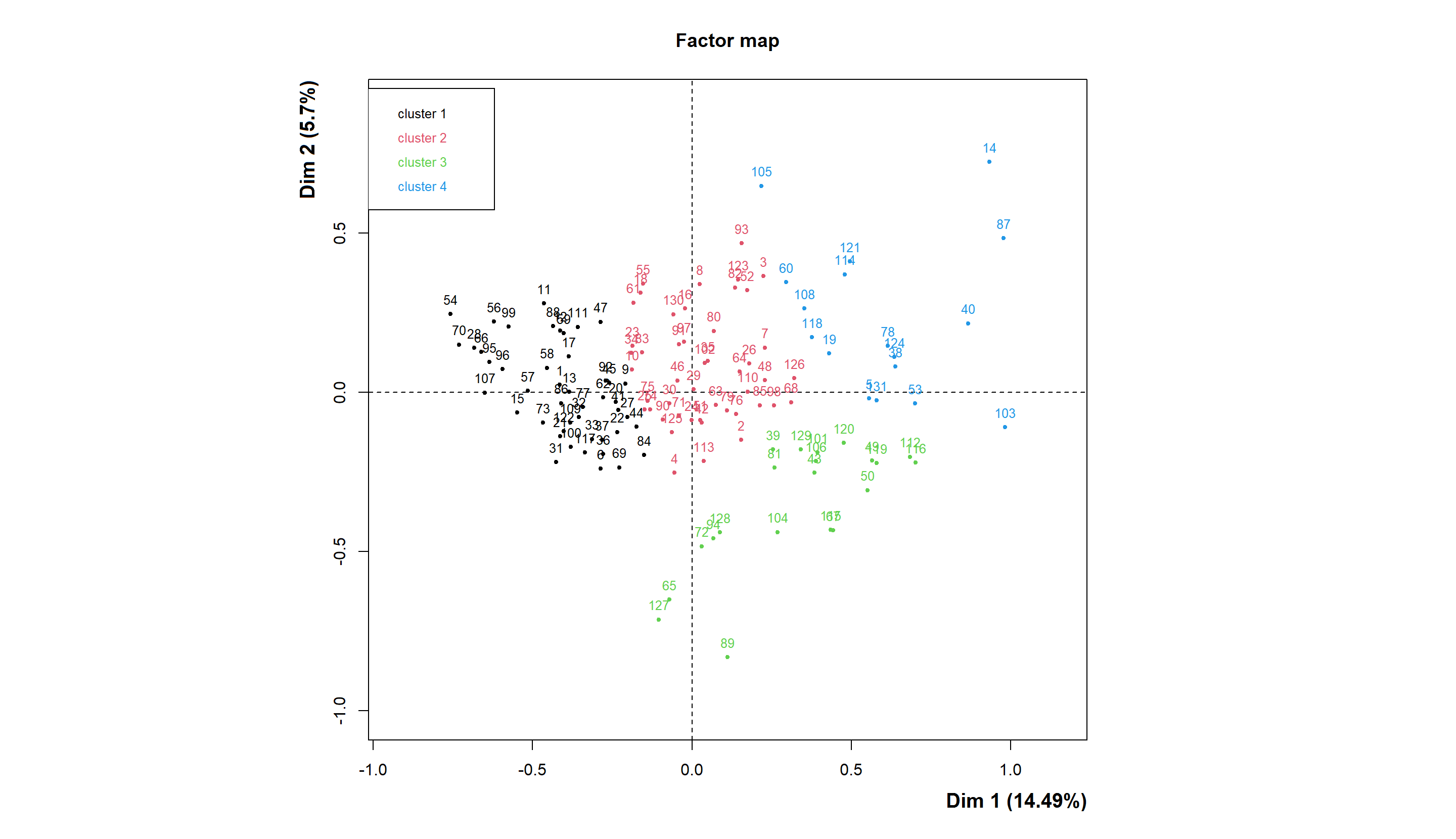
With the help of MCA, 66 eigenvectors were identified. The two most significant vectors explain 14.5% and 5.7% of the variance. The largest contributions to the first vector were responses related to the use of conversion analysis (2.9%), the use of any tools for evaluating marketing effectiveness (2.7%), and content marketing (2.7%). The largest contributions to the second vector were the absence of sales increase as a goal (4.9%) and not using television advertising (4.6%). Figure 1 shows the dispersion of all 131 observations in the space of these two eigenvectors, which helped identify the corresponding clusters.
Fig. 1. Arrangement of questionnaires and clusters according to the two most explanatory eigenvectors obtained using MCA
LIMITATIONS OF THE STUDY
This study has several limitations that are important to mention. Online surveying was chosen as a suitable method, which is both efficient and fast and does not require significant financial resources. However, a limitation is that not all small and medium-sized enterprise (SME) managers regularly check their email, which affected the size of the achieved sample. It is also necessary to mention the limitation of self-completed questionnaires. It often happens that respondents do not understand or misinterpret the questions. Some respondents (entrepreneurs) are discouraged from participating in the survey because they do not always want to openly answer questions related to their business. This is indicated by the number of questionnaire views, which is almost three times larger than the number of respondents who completed them.
Descriptive Statistics
Regarding the organization of marketing activities, some uneven distribution of responses is noted (in this regard, the Chi-square and Fisher's exact tests are not applicable). Among microenterprises, more often than not, nobody is involved in marketing; however, there are those who employ both in-house (8) and outsourced (1) marketers (Table 2). In a microenterprise, defined as having fewer than ten employees, the inclusion of a dedicated marketer is of interest; this contrasts with large businesses where the company's leader often takes on the role of marketing.
Table 2. Frequency distribution of answers to the question “How are marketing activities organized in your firm/company?”
|
Enterprise size |
|||
Possible answer |
micro |
small |
medium |
large |
There is a marketer on staff |
8 |
6 |
2 |
2 |
We use the services of a third-party marketer |
1 |
0 |
0 |
4 |
Marketing is carried out by the head of the company/company |
10 |
10 |
10 |
14 |
Nobody does marketing |
32 |
13 |
5 |
1 |
Other, please specify what exactly |
6 |
5 |
2 |
0 |
The most significant differences were found in planning and marketing methods. What's interesting is the common ground shared by businesses of different sizes: everyone utilizes mobile and email marketing, advertising on social networks, messengers, and classified ads. Statistical tests did not reveal significant differences in the following areas:
The role of the owner of the firm in marketing the enterprise.
Modern digital technologies - except for some, more commonly used by larger enterprises, such as IoT, Big Data, chatbots. Some tools are equally used by all (e.g., cloud services), while others are not used by anyone (like Blockchain).
Differences in the problems faced by firms were evaluated differently by various methods. Notably, budget-related issues, which are more pronounced for small enterprises, as well as the likelihood of data leaks.
Detailed descriptive statistics are presented in the Appendix, Tables 1-4.
The research identified four clusters based on the marketing strategies employed. First and foremost, two distinct poles stand out, Cluster 1 (enterprises less advanced in digital marketing) and Cluster 4 (the most advanced enterprises in digital marketing). Representatives in the first cluster are largely disengaged from marketing or have a general involvement, which is reflected in the structure of the digital technologies and marketing channels they use. Representatives in the most advanced cluster often use complex tools more frequently than others and are often dissatisfied with the results. Clusters 2 (enterprises with complex marketing strategies but limited resources) and 3 (enterprises that combine traditional and digital marketing methods) can be positioned between these two poles, but they fundamentally adopt two different approaches, which seemingly reflect differences in their sizes.
According to Table 5 (Appendix), microenterprises and small businesses make up the majority in clusters 1 and 2. In cluster 3, on the contrary, large businesses have the majority, and in cluster 4 all four categories are most evenly distributed.
The predominance of companies with fewer than fifty employees is explained by sample characteristics. However, the data align with previous research indicating that small and medium-sized businesses, for the most part, may lag behind large enterprises but can identify and attempt to leverage their advantages.
Cluster 1, enterprises less advanced in digital marketing, consists of 46 enterprises (35% of the sample).
In these companies, the role of a marketer is less prominent, with owners often taking on this responsibility or no one being specifically responsible for marketing (this cluster includes almost all enterprises where no one is responsible for marketing). About 20% of the cluster have utilized the services of marketing firms.
In this cluster, expectations from marketing activities are low or undefined. They less frequently utilize all the marketing channels listed, and modern technologies are used less frequently compared to other clusters (57% versus 0-24% in other clusters). The most popular marketing channel is social media (59%), followed by advertising on classified ad websites (43%), such as the Moldovan website 999.md. The next popular channel is leaflets, used by one-fifth of the cluster. Only in this cluster are there firms/companies that do not use any marketing channels. Notably, there are firms in this cluster that do not use any marketing channels, suggesting a lack of awareness or resources to engage in promotional activities. Representatives of firms/companies in this cluster often complain about a lack of budget (43%).
Cluster 2, enterprises with complex marketing and limited resources, comprises 47 firms/companies (36% of the sample).
This cluster is predominantly made up of micro and small enterprises, but a few large firms/companies are also included. While this cluster does not possess the resources of clusters 3 and 4, it does have a marketing presence, and in some aspects, it employs more complex marketing methods than cluster 3. In this cluster, marketing is still often handled by the firm's leader (47%), but more frequently than in cluster 1, the firm/company hires an in-house marketer (32%) or an outsourced employee (17%). Like cluster 1, this cluster also encounters budget constraints and a knowledge deficit, but to a lesser extent than clusters 3 and 4 (around 40% for the first two compared to 20% for the others). One informant wrote, "There is not enough time for everything. I am the leader and oversee all types of activities."
Representatives of this cluster are more advanced in some modern technologies than those in clusters 1 and 3 (including cloud services and neural networks), but they do not employ more advanced technologies (such as the Internet of Things, Big Data, process automation, etc.). They often (again, less than cluster 4 but more than clusters 1 and 3) identify problems with employee qualifications and express dissatisfaction with marketing results. They most frequently use social media (94%) and advertise on classified ad websites (55%), sometimes venturing into more complex tools (SEO 45%, PPC 30%, video marketing 30%).
Cluster 3, enterprises that combine traditional and digital marketing methods, comprises 21 firms/companies
In this cluster, more than half are large firms/companies, but representatives of SMEs are also included. In these firms, marketing is more frequently managed by someone other than the owner (72%). However, they more often declare that the owner sets the direction of development (100%) and oversees the results (57%). There is a higher demand for marketers in this cluster (Table 9), and at the same time, representatives of this cluster are more satisfied with the results compared to clusters 2 or 4. This cluster includes the overwhelming majority of Moldovan large enterprises surveyed (with a staff of 250 or more people), typically well-established in both the domestic and international markets, and whose trade brands are fairly well-known.
This cluster, more than others, utilizes classical and non-budget-friendly marketing channels: video marketing (81%), TV advertising (76%), radio (67%), and billboards (62%). However, they don't limit themselves to these and also reach customers through social networks (95%), leaflets (71%), partnerships (57%), and more. Some companies in cluster 3 engage in complex internet channels: SEO (43%), PPC (43%), and email marketing (37%) - however, with resources available, they do not strive to use modern technologies (the most common are cloud services (43%) and neural networks (14%). It is noteworthy that 33% had difficulty answering the question about modern technologies, and 24% admitted not using any. Compared to the first cluster, in which 57% of respondents admitted not using any modern technologies and only 7% had difficulty answering, in cluster 3, around a third of respondents had difficulty answering, possibly due to a reluctance to admit lagging behind.
Cluster 3 more frequently employs complex modern technologies, including robotics (71% compared to 2-15% in other clusters), machine learning (47% compared to 0-4% in other clusters), etc. Among their channels, they also emphasize the internet, including search advertising (88%) and search engine optimization (82%), less frequently using radio and TV (29%) and leaflets (53%).
Cluster 4, the most advanced enterprises in digital marketing, consists of 17 firms/companies (13% of the sample).
These enterprises also do not face budgetary problems (18%) or knowledge deficits in digital marketing (18%), but they more often than others experience a shortage of qualified personnel (88%). One respondent complained not only about in-house staff but also outsourced marketers: "The competence of outsourcing specialists is minimal compared to the in-house team." Nevertheless, this cluster more frequently than others sought the services of marketing firms.
These firms have higher expectations compared to others, citing challenges such as a small audience, low conversion rates, and the ineffectiveness of advertising campaigns. Compared to cluster 3, this cluster sets fewer goals and evaluates the results less positively.
Detailed data related to clusters are presented in the Appendix. Tables 5-10.
CONCLUSIONS
This research yielded the following findings: the impact of enterprise size on marketing strategies, including the use of digital marketing tools, was examined. In line with previous studies, it was assumed that micro, small, and medium-sized enterprises, due to resource constraints, would be less advanced in the use of digital marketing tools (H1 and H2). This hypothesis was partially confirmed. On one hand, a significant number of SMEs were categorized into the cluster of less advanced firms/companies. This result aligns with the Resource-Based View, which emphasizes how resource constraints can influence an organization's strategic decisions and capabilities. On the other hand, a certain portion of SMEs placed significant importance on marketing activities (cluster 2 - complex marketing with limited resources) and used relatively advanced digital marketing tools such as SEO, PPC, and video marketing. This adaptation showcases resourcefulness within constraints, a principle of the Resource-Based Theory. The research findings underscore the relevance of Dynamic Capability Theory by highlighting how enterprises, especially SMEs, leverage adaptability, innovation, and knowledge to navigate challenges in digital marketing. The theory's emphasis on organizational learning, flexibility, and resource reconfiguration aligns with the observed variations in digital marketing strategies among enterprises of different sizes in Moldova.
The research identified the peculiarities of the marketing strategy of large enterprises in Moldova. Confirmation was found for H3 and H4, which suggests that large enterprises employ a more diverse range of marketing channels. In addition to popular digital marketing channels like social networks, large firms/companies extensively use traditional, more expensive channels such as television and radio advertising, billboards, leaflets, and business cards. For large firms, it's important to reach a broader audience, which may not always be active on social networks. Therefore, they utilize traditional channels to reach their target audience, which might not always be reached through digital channels. Expensive traditional channels are used to maintain and strengthen their brand and market status, giving the company a more serious and significant image. This indicates that large companies recognize the importance of combining different marketing channels, including traditional ones, even when digital alternatives are available. They aim to diversify their marketing efforts to achieve maximum impact and cater to the needs of various segments of their audience.
The study found that social media is the most commonly used form of digital marketing. In all clusters, with the exception of the first, the share of those using social networks reaches almost 90%. This is in line with previous research (Melović et al., 2020; Nadanyiova et al., 2021; Inayatulloh et al., 2023). At the same time, advertising on the Internet on the 999.md board is also the most used tool. Google analytics, social media metrics analysis and traffic analysis were the most common ways to measure digital marketing effectiveness in all clusters, excluding the first (enterprises less advanced in digital marketing). About half of enterprises in the first cluster do not analyze the effectiveness of marketing activities.
The utilization of diverse marketing channels (H4) by large enterprises aligns with the notion of dynamic capabilities. These firms, by employing both traditional and digital channels, demonstrate flexibility in their marketing approaches. Dynamic Capability Theory emphasizes that firms need to possess the flexibility to reconfigure resources and activities in response to changing market conditions. Large enterprises employing multiple marketing channels exhibit this flexibility, ensuring they can adapt their strategies to reach different segments of their audience and maintain a robust brand presence.
The hypothesis that "A shortage of qualified personnel hinders progress in the field of digital marketing" was fully confirmed (H5). This issue was more frequently mentioned by representatives of large businesses, who also critically evaluated the services of specialized marketing companies (cluster 4). These firms/companies do not face problems with budgeting for marketing activities and are advanced in digital marketing; they can finance marketing research and campaigns. However, despite this, they often encounter the problem of a shortage of qualified employees because they have high standards of quality and personnel requirements. They face issues such as a small audience and low conversion rates, indicating that they set high goals but encounter real challenges in achieving them. Consequently, these companies face challenges in personnel management and achieving high marketing objectives.
The study revealed the challenges that businesses in Moldova face in their marketing activities. The most indicative aspect in this regard is the proportion of enterprises belonging to the first cluster, comprising more than a third of the entire sample, which are the least advanced in digital marketing, the vast majority being micro and small enterprises. Representatives of SMEs more frequently pointed out the lack of resources (personnel, finances, time) as a significant challenge. These difficulties are also characteristic of medium and some large businesses, which may be related to bureaucratic constraints, a lack of flexibility in resource management, and the complexity of implementing changes.
Overall, this research highlights the need for greater support for SMEs in the implementation of digital marketing, which can be part of a broader strategy to encourage the digital transformation of small and medium-sized enterprises. Attention should be directed towards improving the training of professionals in marketing and entrepreneurship, providing accessible and high-quality educational programs, and offering consultations in the field of digital marketing.
Appendix
I. Descriptive Statistics
Table 1. Expectations of entrepreneurs from marketing activities depending on the size of enterprises
Possible answer
|
P-value, Chi-square |
P-value, Fisher |
% of enterprises that responded positively |
|||
|
|
|
micro |
small |
medium |
large |
Attracting new customers and increasing sales* |
0.187 |
0.205 |
84 |
85 |
100 |
95 |
Retention of existing clients |
<0.001 |
<0.001 |
54 |
47 |
47 |
100 |
Increasing brand awareness |
0.007 |
0.005 |
54 |
62 |
84 |
90 |
Market expansion, for example, through the launch of new products or services |
<0.001 |
<0.001 |
32 |
47 |
68 |
90 |
Improving the image of the company/company |
0.012 |
0.01 |
47 |
50 |
68 |
86 |
Increased sales |
<0.001 |
<0.001 |
42 |
53 |
79 |
90 |
Increased profits |
0.001 |
<0.001 |
47 |
38 |
58 |
90 |
Improving conversions on a website or online store |
0.009 |
0.01 |
19 |
24 |
47 |
52 |
Increasing market share |
<0.001 |
<0.001 |
19 |
32 |
58 |
71 |
Table 2. Tools used by the firm/company to assess the effectiveness of marketing activities
Possible answer |
P-value, Chi-square |
P-value, Fisher |
% of enterprises that responded positively |
|||
|
|
|
micro |
small |
medium |
large |
External analytical systems such as Google Analytics, Yandex Metrika |
0,117 |
0,119 |
46 |
50 |
53 |
76 |
Traffic analysis |
0,049 |
0,051 |
30 |
32 |
47 |
62 |
Conversion Analysis |
0,017 |
0,015 |
32 |
18 |
53 |
52 |
CRM systems |
0,003 |
0,004 |
23 |
24 |
47 |
62 |
Customer surveys |
0,057 |
0,056 |
37 |
18 |
32 |
52 |
Social media metrics analysis |
0,013 |
0,014 |
33 |
32 |
47 |
71 |
ROi analysis * |
0,003 |
0,003 |
11 |
9 |
37 |
38 |
We do not use any * |
0,153 |
0,149 |
19 |
29 |
16 |
5 |
Difficult to answer * |
0,252 |
0,275 |
4 |
3 |
5 |
14 |
Table 3. Marketing channels used to promote the company/products/services
Possible answer
|
P-value, Chi-square |
P-value, Fisher |
% of enterprises that responded positively |
|||
|
|
|
micro |
small |
medium |
large |
Advertising on trading platforms and message boards such as 999.md, etc. |
0.26 |
0.267 |
54 |
41 |
32 |
38 |
Leaflets, business cards |
0.004 |
0.004 |
26 |
41 |
47 |
71 |
TV ads * |
<0.001 |
<0.001 |
9 |
18 |
21 |
62 |
Radio advertising * |
<0.001 |
<0.001 |
12 |
24 |
32 |
57 |
Advertising on street billboards |
0.004 |
0.007 |
19 |
18 |
32 |
57 |
Search Engine Optimization (SEO) |
0.082 |
0.084 |
26 |
38 |
42 |
57 |
Search advertising (PPC) |
<0.001 |
<0.001 |
19 |
24 |
42 |
71 |
Social networks (Facebook, Instagram, Twitter, LinkedIn, etc.) * |
0.334 |
0.308 |
77 |
79 |
79 |
95 |
Email Marketing * |
0.067 |
0.058 |
14 |
24 |
37 |
38 |
Mobile marketing (mobile applications, SMS mailings) * |
0.352 |
0.341 |
12 |
15 |
21 |
29 |
Video marketing (YouTube, Vimeo, etc.) |
<0.001 |
<0.001 |
23 |
26 |
42 |
71 |
Content marketing (blogs, articles, infographics, etc.) |
0.002 |
0.003 |
18 |
18 |
37 |
57 |
Affiliate marketing (collaboration with partners) |
0.006 |
0.007 |
19 |
21 |
37 |
57 |
Advertising in instant messengers (WhatsApp, Viber, Telegram, etc.) * |
0.028 |
0.036 |
9 |
18 |
5 |
33 |
Advertising on forums and communities * |
0.063 |
0.064 |
9 |
15 |
21 |
33 |
None * |
0.336 |
0.462 |
5 |
9 |
0 |
0 |
Table 4. Share of firms/companies that have sought the services of specialized marketing firms over the past 12 months
Possible answer |
micro |
small |
medium |
large |
Used the services of marketing firms |
19 |
8 |
8 |
13 |
Have not used the services of marketing firms |
38 |
26 |
11 |
8 |
Chi-square statistics |
8.8042 |
|
|
|
P-value, Chi-square |
0.03201 |
|
|
|
P-value, Fisher's exact test |
0.03462 |
|
|
|
Table 5. Frequency of enterprises of different sizes by cluster
Enterprise size
|
Clusters |
|||
|
1 less advanced |
2 complex marketing with limited resources |
3 combining traditional and digital marketing channels |
4 most advanced |
Up to 9 people |
23 |
26 |
4 |
3 |
10 – 49 |
18 |
13 |
1 |
2 |
50 – 249 |
4 |
7 |
3 |
6 |
250 and more |
1 |
3 |
13 |
6 |
Table 6. Enterprises by marketing organization and by cluster, %
Possible answer |
1 |
2 |
3 |
4 |
There is a marketer on staff |
17 |
32 |
67 |
41 |
We use the services of a third-party marketer |
7 |
17 |
5 |
18 |
Marketing is carried out by the head of the company/company |
48 |
47 |
19 |
18 |
Nobody does marketing |
28 |
4 |
0 |
6 |
Other |
0 |
0 |
10 |
18 |
Table 7. Share of enterprises in the cluster that expressed this expectation from marketing, %
Possible answer |
1 |
2 |
3 |
4 |
Attracting new customers and increasing sales volume |
76 |
94 |
100 |
94 |
Retention of existing clients |
43 |
53 |
95 |
71 |
Increasing brand awareness |
39 |
68 |
100 |
94 |
Market expansion, for example, through the launch of new products or services |
30 |
43 |
95 |
71 |
Improving the image of the company/company |
41 |
53 |
90 |
71 |
Increased sales |
43 |
51 |
100 |
65 |
Increased profits |
35 |
53 |
86 |
65 |
Improving conversions on a website or online store |
7 |
26 |
71 |
53 |
Increasing market share |
15 |
32 |
81 |
53 |
I find it difficult to answer |
4 |
0 |
0 |
0 |
Table 8. Share of enterprises in the cluster using the listed marketing channels, %
Possible answer |
1 |
2 |
3 |
4 |
Advertising on trading platforms and message boards such as 999.md, etc. |
43 |
55 |
33 |
35 |
Leaflets, business cards |
20 |
43 |
71 |
53 |
TV ads |
2 |
13 |
76 |
29 |
Radio advertising |
11 |
19 |
67 |
29 |
Advertising on street billboards |
13 |
19 |
62 |
41 |
Search Engine Optimization (SEO) |
9 |
45 |
43 |
82 |
Search advertising (PPC) |
9 |
30 |
43 |
88 |
Social networks (Facebook, Instagram, Twitter, LinkedIn, etc.) |
59 |
94 |
95 |
88 |
E-mail Marketing |
0 |
26 |
38 |
65 |
Mobile marketing (mobile applications, SMS mailings) |
4 |
17 |
10 |
59 |
Video marketing (YouTube, Vimeo, etc.) |
4 |
30 |
81 |
71 |
Content marketing (blogs, articles, infographics, etc.) |
2 |
23 |
52 |
71 |
Affiliate marketing (collaboration with partners) |
7 |
23 |
57 |
65 |
Advertising in instant messengers (WhatsApp, Viber, Telegram, etc.) |
7 |
9 |
29 |
35 |
Advertising on forums and communities |
0 |
13 |
43 |
35 |
None |
13 |
0 |
0 |
0 |
Table 9. Share of enterprises using the specified methods for assessing efficiency, by cluster, %
Possible answer |
1 |
2 |
3 |
4 |
External analytical systems such as Google Analytics, Yandex Metrika |
20 |
68 |
62 |
88 |
Traffic analysis |
9 |
43 |
57 |
82 |
Conversion Analysis |
0 |
43 |
48 |
88 |
CRM systems |
2 |
40 |
48 |
76 |
Customer surveys |
13 |
43 |
43 |
53 |
Social media metrics analysis |
15 |
47 |
52 |
82 |
ROi analysis * |
0 |
15 |
33 |
59 |
We do not use any * |
52 |
2 |
0 |
0 |
Difficult to answer * |
7 |
0 |
19 |
0 |
Table 10. Share of enterprises in the cluster experiencing the listed difficulties, %.
Possible answer |
1 |
2 |
3 |
4 |
Not enough budget |
43 |
38 |
19 |
18 |
Not enough qualified employees |
35 |
60 |
48 |
88 |
Not enough effective marketing campaigns |
9 |
32 |
14 |
18 |
Lack of understanding of the market and audience |
17 |
21 |
0 |
18 |
Insufficient audience (insufficient number of visitors to the website or social networks) |
2 |
21 |
19 |
41 |
Low level of conversion (actions, reactions, filling out the feedback form, etc.) |
2 |
32 |
14 |
47 |
Insufficient effectiveness of advertising campaigns |
7 |
15 |
10 |
35 |
Insufficient data protection (confidential information leaks) |
0 |
2 |
0 |
12 |
Lack of knowledge in the field of digital marketing (difficulties in choosing promotion channels, creating advertising materials, etc.) |
35 |
34 |
14 |
18 |
Other |
13 |
4 |
38 |
6 |
We have no problems |
0 |
2 |
0 |
6 |
REFERENCES
Bachev, H. (2004). Governing of Marketing in Bulgarian Farms. Available at SSRN Electronic Journal. https://doi.org/10.2139/ssrn.903505
Barney, J. B. (1996). The resource-based theory of the firm. Organization science, 7(5), 469-469. https://doi.org/10.1287/orsc.7.5.469
Barrales-Molina, V., Martínez-López, F. J., & Gázquez-Abad, J. C. (2017). Dynamic Marketing Capabilities: An Integrative Framework Proposal to Absorb and Manage Market Knowledge. In Developments in Marketing Science: Proceedings of the Academy of Marketing Science (pp. 176–176). Developments in Marketing Science: Proceedings of the Academy of Marketing Science. https://doi.org/10.1007/978-3-319-50008-9_45
Becker, W., & Schmid, O. (2020). The right digital strategy for your business: an empirical analysis of the design and implementation of digital strategies in SMEs and LSEs. Business Research, 13, 985–1005. https://doi.org/10.1007/s40685-020-00124-y
Belas, J., Gavurova, B., Novotna, L., & Smrcka, L. (2022). Examination of differences in using marketing tools in the management of SMEs in the Visegrád Group countries. Amfiteatru Economic, 24(60), pp. 447-463. https://doi.org/10.24818/EA/2022/60/447
Bengtsson, M., Boter, H., & Vanyushyn, V. (2007). Integrating the Internet and Marketing Operations: A Study of Antecedents in Firms of Different Size. International Small Business Journal, 25(1), 27-48. https://doi.org/10.1177/0266242607071780
Bodlaj, M., & Rojšek, I. (2014). Marketing in Small Firms: The Case of Slovenia. Economic and Business Review, 16(2). https://doi.org/10.15458/2335-4216.1274
Bruni, D. S., & Verona, G. (2009). Dynamic marketing capabilities in science‐based firms: an exploratory investigation of the pharmaceutical industry. British Journal of management, 20, S101-S117. https://doi.org/10.1111/j.1467-8551.2008.00615.x
Canhoto, A. I., Quinton, S., Pera, R., Molinillo, S., & Simkin, L. (2021). Digital strategy aligning in SMEs: a dynamic capabilities perspective. The Journal of Strategic Information Systems, 30(3), 101682. https://doi.org/10.1016/j.jsis.2021.101682
Cenamor, J., Parida, V., & Wincent, J. (2019). How entrepreneurial SMEs compete through digital platforms: The roles of digital platform capability, network capability and ambidexterity. Journal of Business Research, 100, 196-206. https://doi.org/10.1016/j.jbusres.2019.03.035
Datareportal (2023) Digital 2023: Moldova https://datareportal.com/reports/digital-2023-moldova
Homburg, C., & Wielgos, D.M. (2022) The value relevance of digital marketing capabilities to firm performance. Journal of the Academy of Marketing Science, 50, 666–688. https://doi.org/10.1007/s11747-022-00858-7
Husson, F., Josse, J., & Pages, J. (2010). Principal component methods - Hierarchical clustering -Partitional clustering: why would we need to choose for visualizing data? Technical Report of the Applied Mathematics Department (Agrocampus)http://www.sthda.com/english/upload/hcpc_husson_josse.pdf
Husson, F., Josse, J., Le, S., & Mazet, J. (2023). Package FactoMineR [Computer software]. http://factominer.free.fr
Inayatulloh et al., (2023). The effect of using mobile applications, using social media, using E-Commerce, and having IT Knowledge on the performance of SMEs. International Conference on Information Management and Technology (ICIMTech), Malang, Indonesia, 2023, pp. 621-626, https://doi.org/10.1109/ICIMTech59029.2023.10277907
Josse, J., & Husson, F. (2016). missMDA: A package for handling missing values in vultivariate data analysis. Journal of Statistical Software, 70(1), 1–31. https://doi.org/10.18637/jss.v070.i01
Kim, K., & Lim, G.G. (2022). International Dynamic Marketing Capabilities of Emerging-Market Small Business on E-commerce. Preprints. https://doi.org/10.20944/preprints202110.0068.v2
Koh, K.-Y., Ahmad, S., Lee, J., Suh, G.-H., & Lee, C.-M. (2022). Hierarchical Clustering on Principal Components Analysis to Detect Clusters of Highly Pathogenic Avian Influenza Subtype H5N6 Epidemic across South Korean Poultry Farms. Symmetry, 14(3), 598. https://doi.org/10.3390/sym14030598
Kotler, P., Kartajaya, H., & Setiawan, I. (2017). Marketing 4.0. Moving from Traditional to Digital. Hoboken: John Willey & Sons.
Kwon, Y. (2021) Impacts of Dynamic Marketing Capabilities on Performance in Exporting. Open Journal of Business and Management, 9, 2119-2135. https://doi.org/10.4236/ojbm.2021.95112
McCartan, A. (2023). Marketing and performance in small firms: the role of networking. Journal of Research in Marketing and Entrepreneurship, 25(1), 150-182. https://doi.org/10.1108/JRME-01-2022-0007
Melović, B., Jocović, M., Dabić, M., Vulić, T. B., & Dudic, B. (2020). The impact of digital transformation and digital marketing on the brand promotion, positioning and electronic business in Montenegro. Technology in Society, 63, 101425. https://doi.org/10.1016/j.techsoc.2020.101425
Moen, Ø. (2000). SMEs and International Marketing: Investigating the Differences in Export Strategy Between Firms of Different Size. Journal of Global Marketing, 13(4), 7–28. https://doi.org/10.1300/J042v13n04_02
Nadanyiova, M., Majerova, J., & Gajanova, L. (2021). Digital marketing as a source of competitive advantage: case study of Slovak Republic. Marketing and Management of Innovations, 4, 92-103. https://doi.org/10.21272/mmi.2021.4-08
Nordin, N., Samsudin, M., & Yusoff, Y. (2023). Social Networking Using Social Media for Small Enterprises: Strategies, Challenges and Measure of Success. International Journal of Advanced Research in Economics and Finance, 5(1), 28-39. Retrieved from https://myjms.mohe.gov.my/index.php/ijaref/article/view/21652
NRA (2023) National Regulatory Agensy for Eelectronic Communication and Information Tehnology of the Republic of Moldova. Retrieved from https://en.anrceti.md/news_130922
Quinton, S., Canhoto, A., Molinillo, S., Pera, R., & Budhathoki, T. (2018). Conceptualising a digital orientation: antecedents of supporting SME performance in the digital economy. Journal of Strategic Marketing, 26(5), 427-439. https://doi.org/10.1080/0965254X.2016.1258004
Rizvanović, B., Zutshi, A., Grilo, A., & Nodehi, T. (2023). Linking the potentials of extended digital marketing impact and start-up growth: Developing a macro-dynamic framework of start-up growth drivers supported by digital marketing. Technological Forecasting and Social Change, 186(A), 122128. https://doi.org/10.1016/j.techfore.2022.122128
Saura, J. R., Palacios-Marqués, D., & Ribeiro-Soriano, D. (2023). Digital marketing in SMEs via data-driven strategies: Reviewing the current state of research. Journal of Small Business Management, 61(3), 1278-1313. https://doi.org/10.1080/00472778.2021.1955127
Setkute, J., & Dibb, S. (2022). “Old boys’ club”: Barriers to digital marketing in small B2B firms. Industrial Marketing Management, 102, 266–279. https://doi.org/10.1016/j.indmarman.2022.01.022
Taiminen, H. M., & Karjaluoto, H. (2015). The usage of digital marketing channels in SMEs. Journal of small business and enterprise development, 22(4), 633-651. https://doi.org/10.1108/JSBED-05-2013-0073
Teece, D. J., Pisano, G., & Shuen, A. (1997). Dynamic capabilities and strategic management. Strategic Management Journal, 18(7), 509-533. https://www.jstor.org/stable/3088148
Wernerfelt, B. (1984). A resource‐based view of the firm. Strategic Management Journal, 5(2), 171-180. http://www.jstor.org/stable/2486175